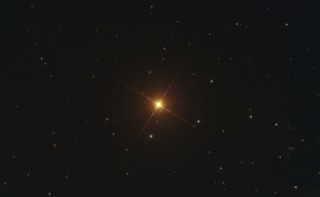
- Constellation: Canes Venatici
- Right Ascension: 12h 45m 07.826s
- Declination: +45° 26′ 24.93″
- Distance: 760 - 1000 ly
- Apparent Magnitude: +4.86 - +7.32
Also know as its popular name La Superba, a giant red star, and one of the reddish known with a B-V index of 2.54. A carbon in the star's outer shell absorbs blue light giving its distinctive reddish light. Primary has a 160 day cycle in its magnitude variations. The star is in its final stages of its evolution and is expected to expel its outer layers in the future, and form a planetary nebula before shrinking down to become a slowly cooling white dwarf.
- Details
- Category: Stars
- Telescope: GSO RC10
- Camera: ZWO 2600 MM
- Constellation: Sagittarius
- Right Ascension: 18h 03m 32.14s
- Declination: -30d 02m 06.96s
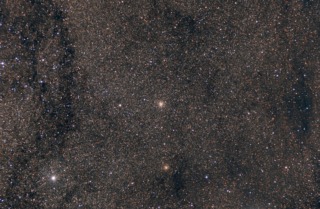
Baade's Window is the largest of 6 relative dust free zones allowing astronomers to study stars in the central bulge of the Milky Way Galaxy. Nothing illustrates the billions of stars in our galaxy like a view of the view of the galactic center, even if only a tiny slice.
Also visible are two globular clusters, NGC 6522 at the center and NGC 6528 below. NGC 6522 is centered in the view of Baade's Window, and at an estimated age of 12 billion years makes it one of the oldest around our galaxy and lies at a distance of 25,100 light years. NGC 6528 is 25,800 light years distant and is unusually meta rich for a globular
The bright star in the lower left is W Sgr, which is a multiple star system, and the primary star is a classical Cepheid variable star that it's magnitude varies over 7 1/2 days.
- Details
- Category: Stars
- Telescope: Explore Scientific 127 Refractor
- Camera: ZWO 2600 MM
- Constellation: Sagittarius
- Right Ascension: 18h 49m 49.36216s
- Declination: –23° 50′ 10.4291″
- Distance: 9.7 ly
- Apparent Magnitude: 10.4
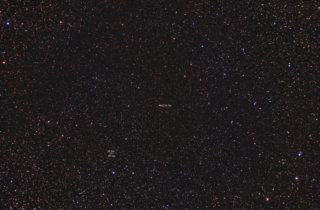
Ross 154, also known as V1216 Sgr is a red dwarf UV Ceti type flare star. Studied by Frank Elmore Ross in the 1920's for its variability and its proper motion. Located some 9.7 light years away, makes it currently the 6th closest star to our solar system. Despite the closeness, being a red dwarf, its magnitude is only 10.4 which requires an optical aid to see it. It's estimated to be a relative young star at an age of 1 billion years. And so far no planets or circumstellar dust disk has been detected around it.
- Details
- Category: Stars
- Telescope: Explore Scientific 127 Refractor
- Camera: ZWO 2600 MM
- Constellation: Sagittarius
- Right Ascension: 17h 52m 00.72665s
- Declination: −28° 01′ 20.5622″
- Distance: 1,359 - 6,000+
- Apparent Magnitude: 8.59 - 11.0
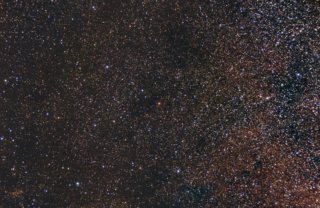
A very large red giant star located withing the constellation bounds of Sagittarius. If it was located where our Sun was, it would extend out past Mars. A pulsating long period variable star with a long period of around 670 days. It varies in magnitude from 8.5 to 11.0 over its long period, with a smaller magnitude pulsation period of around a third of a day. There are no reliable distance measurements other that its far enough away that parallax measurements are currently unreliable. It is the reddish brighter star located near the center. A rich star field for a back drop as we look towards the center of our Milky Way galaxy.
- Details
- Category: Stars
- Telescope: Explore Scientific 127 Refractor
- Camera: ZWO 2600 MM
- Constellation: Ursa Major
- Right Ascension: 09h 47m 30.71
- Declination: +63° 14` 53.3
- Distance: 246 ly
- Apparent Magnitude: 6.94
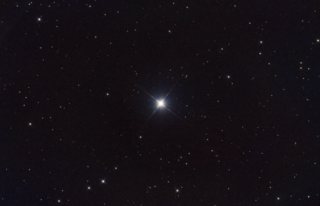
HD 84406 is located in the constellation of Ursa Major, and a yellow star of spectral type G, and shines at a magnitude of 6.9, just dimmer than a person can see without optical aid.
What is special about HD 84406? Actually not too much as stars go, but that is a good thing as it was used for the initial focusing of the new James Webb space telescope.
Some of the constraints were the star would have to be in the field of view for the telescope for the entire collimation of the mirrors. The star couldn't be too bright which would cause issues with the sensors. Also the star needed to be in an uncrowded area by other stars. And of course the star needs to be stable with a constant magnitude.
- Details
- Category: Stars
- Telescope: GSO RC10
- Camera: ZWO 2600 MM
- Constellation: Leo
- Right Ascension: 10h 56m 28.99s
- Declination: +07° 00′ 52.0″
- Distance: 7.9 ly
- Apparent Magnitude: 13.5
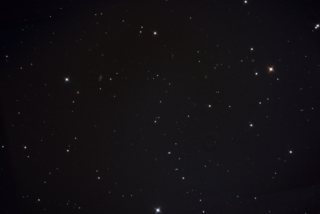
A red dwarf star located in the constellation of Leo, its the reddish star located in the center of the image. It's name comes from astronomer Max Wolf who studied that exhibit large proper motion across the sky. A star with a large proper motion appears to move across the sky over the years. Most are relative close stars that their movement can be measured over the years.
One of the closer stars at 7.9 light years, but because its one of the dimmest of the local red dwarfs, its magnitude is a faint 13.5.
Image of Wolf 359 taken in 2015, compared to its current location shows its movement over the years.
- Details
- Category: Stars
- Telescope: GSO RC10
- Camera: ZWO 2600 MM