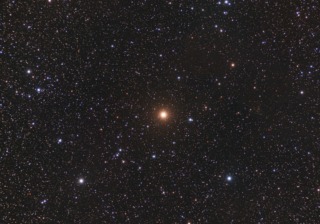
- Constellation: Cepheus
- Right Ascension: 21h 56m 39.14385s
- Declination: +63° 37′ 32.0174″
- Distance: 4,900 ly
- Apparent Magnitude: 4.8 - 5.36
- B-V Color Index: 1.82, 0.36
VV Cephei is another one of the red super giant stars located in our galaxy. It is also an eclipsing binary star system with a much smaller companion star that is close enough to draw off some of outer layers of the primary star. The orbital period of the pair is around 20 years. The interaction of the secondary star pulling off the outer layers makes for some interesting spectroscopic variations as the stars eclipse one another.
- Details
- Category: Stars
- Telescope: Explore Scientific 127 Refractor
- Camera: ZWO 2600 MM
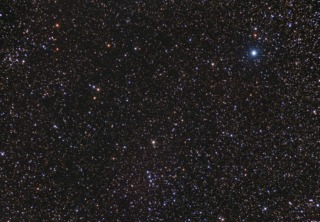
- Constellation: Cepheus
- Right Ascension: 21h 43m 30.4609s
- Declination: +58° 46′ 48.166″
- Distance: 3060 ly
- Apparent Magnitude: 3.4 - 5.1
- B-V Color Index: 2.35
Mu Cephei, or by its popular name Herschel's Garnet Star is hyper-giant red star with a radius of 1,000 times of our sun. It is one of the largest stars visible without optical aid, as its magnitude varies between 3.4 and 5.1. In the live fast die young crowd, it is nearing its end which at that size will be a supernova and possible black hole as a remnant.
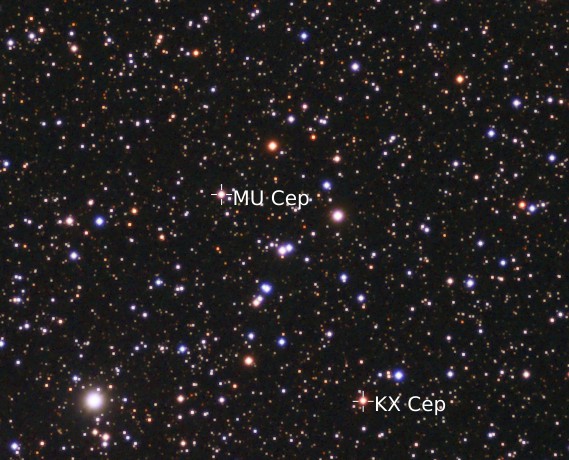
Several other objects are visible in the field of view.
- Details
- Category: Stars
- Telescope: Explore Scientific 127 Refractor
- Camera: ZWO 2600 MM
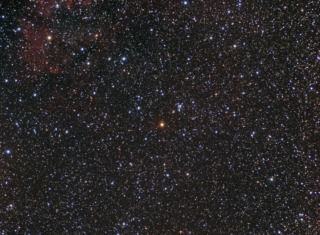
- Constellation: Cepheus
- Right Ascension: 22h 23m 07.01521s
- Declination: +55° 57′ 47.6244″
- Distance: ~29,000 ly
- Apparent Magnitude: 6.0 - 7.3
- B-V Color Index: 2.22
RW Cephei is one of the larger stars know of with its radius extending out to the same distance as Jupiter is to our Sun. It is classified as either a red or yellow hyper giant star depending on how it is measured as it lies some where in between. A semi-regular variable star with one period measured around 346 days.
- Details
- Category: Stars
- Telescope: Explore Scientific 127 Refractor
- Camera: ZWO 2600 MM
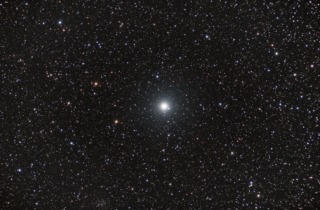
- Constellation: Cassiopeia
- Right Ascension: 00h 49m 06.29070s
- Declination: +57° 48′ 54.6758″
- Distance: 19 ly
- Apparent Magnitude: 3.44, 7.5
- B-V Color Index: 0.58
Lost in the glare of Eta Cassiopeia primary star, Achird, is a dimmer companion. The two stars orbit each other in 480 years. Eta Cassiopeia A is a G type star much like our Sun and similar in size. Eta Cassiopeia B is a dimmer K type star.
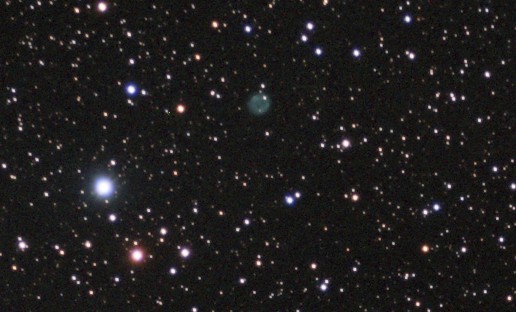
Also visible in the image is a small planetary nebula PK122-04.1 in the upper left side, near the edge of the image.
- Details
- Category: Stars
- Telescope: Explore Scientific 127 Refractor
- Camera: ZWO 2600 MM
- Constellation: Andromeda
- Right Ascension: 23h 41m 55.0361s
- Declination: +44° 10′ 38.825″
- Distance: 10.33 ly
- Apparent Magnitude: 12.23 - 12.34
- B-V Color Index: 1.90
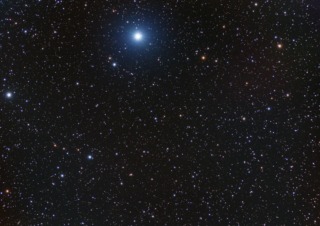
Also known as HH Andromedae is another star located around 10 light years away. Like many stars located around our region, it is a small dim red dwarf star that requires optical aid to even see it. But if you can wait around 40,000 years, it will pass by at a distance of only 1.7 light years.
- Details
- Category: Stars
- Telescope: Explore Scientific 127 Refractor
- Camera: ZWO 2600 MM
- Constellation: Draco
- Right Ascension: 17h 32m 10.5 / 16.0
- Declination: +55° 11′ 03.27 / +55° 10′ 22.6
- Distance: 100 ly
- Apparent Magnitude: 4.88
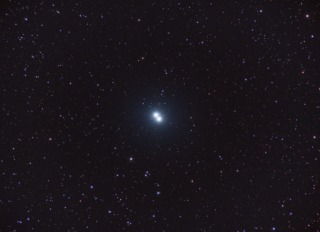
Believed to be a true double star based on their similar motion and distance. The two stars are widely separated at around 1,900 astronomical units, so if they do orbit, it would take in excess of 44,000 years.
Star v1 is a magnitude 4.88 with a B-V color index of 0.26, and a spectral type A8Vm. Star v2 is also a magnitude 4.88, with a B-V color index of 0.27, and a spectral type A4IVm. So both stars appear to be about the same visually. Star v2 is actually a spectroscopic binary.
- Details
- Category: Stars
- Telescope: Explore Scientific 127 Refractor
- Camera: ZWO 2600 MM