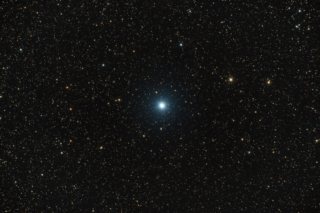
- Constellation: Perseus
- Right Ascension: 03h 08m 10.13245s
- Declination: +40° 57′ 20.3280″
- Distance: 90 ly
- Apparent Magnitude: 2.12 - 3.39
Algol, Beta Persei, sometimes known as the Demon Star was one of the first noticed variable stars, dipping from mag 2.1 to 3.4 every 2 days, 20 hours and 48.8 minutes when a dimmer companion passes in front of it from our viewpoint. Probably noticed by ancient astronomers. It is a multi star system with at least 3 stars in the system. Primary star Beta Persei A is of type B8V, one of the spectroscopic stars B is an orange sub giant of type KOIV, and C is type A7m. The A and B stars are only 0.062 AU apart, while C orbits the pair at 2.69 AU.
7.3 million years ago, Algol came within 9.8 light years of our solar system, it would have shined in the night sky a magnitude brighter than Sirius does today.
It has a very dark reputation in ancient history as a star of death and misfortune.
- Details
- Category: Stars
- Telescope: EDT 80mm Reftactor
- Camera: ZWO A071 Color
- Constellation: Aquarius
- Right Ascension: 22h 38m 33.73s
- Declination: –15° 17′ 57.3″
- Distance: 11.1 ly
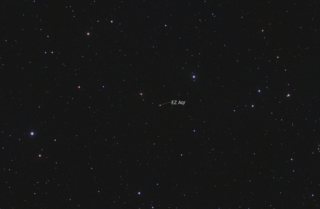
EZ Aqr is a triple red dwarf system 11 light years away. Star "C" of the triplet orbits every 3.8 days, the other one "B" has a 823 day period.
All three of the stars have an estimated mass of a tenth of our Sun. No planetary companions have been found as of yet.
Image from 2005 showing its proper motion through the sky.
- Details
- Category: Stars
- Telescope: Explore Scientific 127 Refractor
- Camera: ZWO 1600 MM
- Constellation: Andromeda
- Right Ascension: 23h 41m 55.0361s
- Declination: +44° 10′ 38.825″
- Distance: 10.3 ly
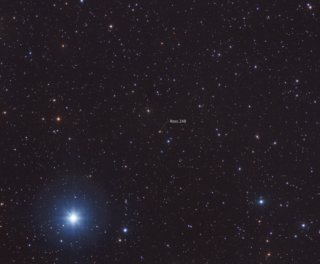
Ross 248 or HH Andromedae is a red dwarf star currently located in Andromeda. At a distance of 103 light years, it is one of the closer stars. In about 33,000 years it will actually be the closest star for about 9,000 years as it comes with in 3 light years before continuing on. Despite its closeness, it shines only at a magnitude 12.3, so its not visible with out a telescope. As like many red dwarf stars, its also a flare star. No unseen companions have been detected around it so far.
As a closer star, some movement is visible in images taken years apart. This animation shows the movement over a 5 year period.
- Details
- Category: Stars
- Telescope: Explore Scientific 127 Refractor
- Camera: ZWO 1600 MM
- Constellation: Aquarius
- Right Ascension: 23h 06m 29.283s
- Declination: −05° 02′ 28.59″
- Distance: 39 ly
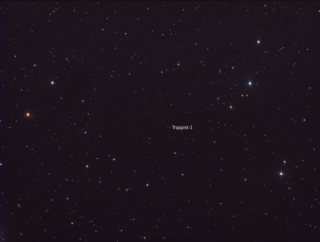
Trappist 1 is an ultra cool red dwarf star currently located in Aquarius. It is slightly larger than Jupiter, but with a mass of over 80 times that of of Jupiter. Three planets were discovered around it in 2015, with 4 more added in 2017. The star is a dim 18.9 magnitude, despite its closeness.
Images taken two years apart indicate it's proper motion across the sky.
- Details
- Category: Stars
- Telescope: Explore Scientific 127 Refractor
- Camera: ZWO 1600 MM
- Constellation: Ophiuchus
- Right Ascension: 17h 57m 48.49803s
- Declination: +04° 41′ 36.2072″
- Distance: 6 ly
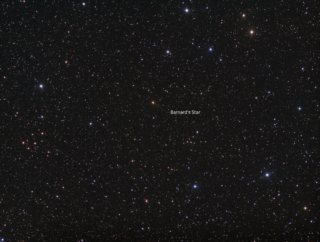
Barnard's Star is a red dwarf located 6 light years away. At mag 9.5 telescope is needed to see it. It displays the highest motion across the sky (proper motion). It's motion is visible in images taken a year apart. My images from 2014-2020.
- Details
- Category: Stars
Read more: Barnard's Star (2020)
- Telescope: Explore Scientific 127 Refractor
- Camera: ZWO 1600 MM
- Constellation: Scorpius
- Right Ascension: 16h 29m 24.45970s
- Declination: −26° 25′ 55.2094″
- Distance: 550 ly
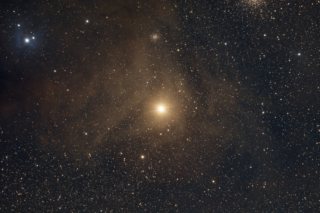
Antares is a swollen red supergiant star located in Scorpius the Scorpion. As the brightest star in that constellation it is designated as Alpha Scorpii. It is the 15th brightest star visible from Earth. It's outer layers are so swollen it would extend out past the orbit of Mars if it was located where our Sun is at. It also has a companion star that is a blue-white main sequence star. It illuminates part of the Rho Ophiuchi cloud complex. As with many stars with this size, it most likely will explode as a supernova in the future.
- Details
- Category: Stars
- Telescope: EDT 80mm Reftactor
- Camera: ZWO A071 Color