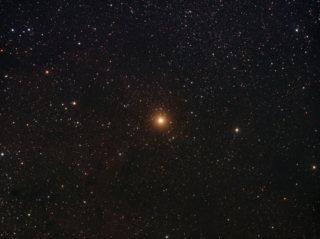
- Constellation: Cepheus
- Right Ascension: 21h 43m 30.4609s
- Declination: +58° 46′ 48.166″
- Distance: 2,800 lly
Also known as Herschel's Garnet Star is a supersized red giant star. It is among one of the larger stars known. If it was located where our Sun is, the outer layer would reach beyond the orbit of Jupiter. The lifetime of massive stars like this are measured in millions of years. Mu Cephei will most likely end as a supernova; with either a neutron star or a black hole remaining. As a (super) red giant, it varies in magnitude between 3.4 and 5.1. It is an estimated distance of 2,800 light years away. Located near the Elephant Trunk Nebula the area has many areas of dust and gas clouds nearby.
- Details
- Category: Stars
- Telescope: EDT 80mm Reftactor
- Camera: ZWO 1600 MM
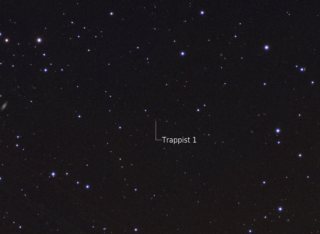
- Constellation: Aquarius
- Right Ascension: 23h 06m 29.283s
- Declination: −05° 02′ 28.59″
- Distance: 39 ly
Trappist 1 is an dim ultra cool red dwarf star located 39 light years away in the constellation of Aquarius. In size, it is only slightly larger than Jupiter but more massive. Despite only being 39 light years away, due to its size and type, it is a dim 18.8 magnitude in the "V" (Green) band and 16.5 magnitude in "R" (Red) band. It is suspected of having seven terrestrial planets orbiting it, detected by transits of the planets across the star's disk. Several could be in a zone where liquid water could exist.
Imaged with the ES127 refractor and Atik 314L+ mono ccd camera.
- Details
- Category: Stars
- Telescope: Explore Scientific 127 Refractor
- Camera: Atik 314l+
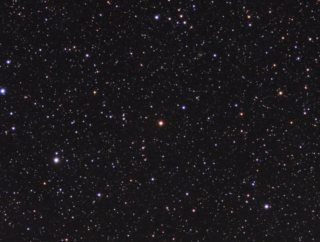
- Constellation: Ophiuchus
- Right Ascension: 17h 57m 48.49803s
- Declination: +04° 41′ 36.2072″
- Distance: 6 ly
Barnard's Star is a low mass red dwarf star 6 light years away from Earth. It's biggest claim to fame is it displays the highest proper motion of any star. Proper motion is the apparent motion across the sky from our viewpoint here on Earth. This is mainly due to its relative closeness and speed and direction of travel in the galaxy. The image is a composite of images taken in July 2014 and merged with an image in July 2018. It's motion in the sky is apparent. Despite its closeness, being a low mass red dwarf star, its apparent magnitude in the sky is 9.5, requiring a telescope to see it. The star is an estimated 7-12 billion years old, and as a red dwarf it will live a very long lifetime. It will make its closest approach in the year 11,800 AD at 3.75 light years.
- Details
- Category: Stars
- Telescope: Explore Scientific 127 Refractor
- Camera: Atik 314l+
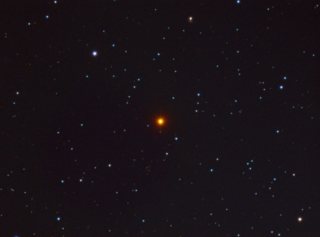
- Constellation: Cancer
- Right Ascension: 08 56 40.1
- Declination: +19 50 57
T Cancri is a red giant variable that gets it's deep reddish color from carbon that is dredged up from its core that forms a fine soot layer that scatters away the blue and green light, much like a sunset does. T Cancri varies in brightness from a magnitude 7.6 down to 10.5 in the green light band over a period of around 482 days. It was around magnitude 8.6 when this image was taken.
- Details
- Category: Stars
- Telescope: Explore Scientific 127 Refractor
- Camera: Atik 314l+
- Constellation: Canes Venatici
- Right Ascension: 12h 45m 07.83s
- Declination: +45° 26′ 24.92″
- Distance: 1,000
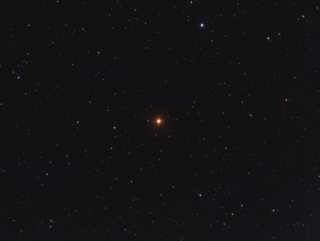
Other names for La Superba are Y CVn, and HD 110914. La Superba is a late stage red giant star, with a mass of three times that of our Sun, but with its outer layers extending out to a radius of 2.2 Astronomical units (1 AU is the distance of the Earth to the Sun). So if La Superba was at the same location as our Sun, it's outer layers would extend out to Mars. Like many red giants, it is also a variable star changing in brightness by around 1 magnitude over a 160 day cycle.
It is also a carbon star, with large amounts of carbon molecules in its outer layers that absorb blue and violet light, giving the star a deep reddish color. Eventually it will shed its outer layers and create a planetary nebula, while the core becomes a white dwarf star that is no longer fusing atoms and slowly cools over trillions of years.
The background contains an large number of barely visible and very distant galaxy that are highlighted with plate-solving the image.
There is also an interesting video highlighting the differences in sizes among stars, and this one includes La Superba to give an interesting view of the scale of it.
- Details
- Category: Stars
- Telescope: EDT 80mm Reftactor
- Camera: ZWO 1600 MM
- Constellation: Orion
- Right Ascension: 05 06 03.44
- Declination: +04 06 08.8
- Apparent Magnitude: 8.9 - 14.7 V
As Orion sets in the western sky, I say goodbye to one of the long period variable stars I follow until Fall when it starts rising in the east.
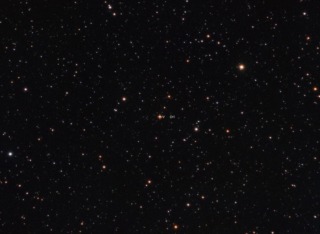
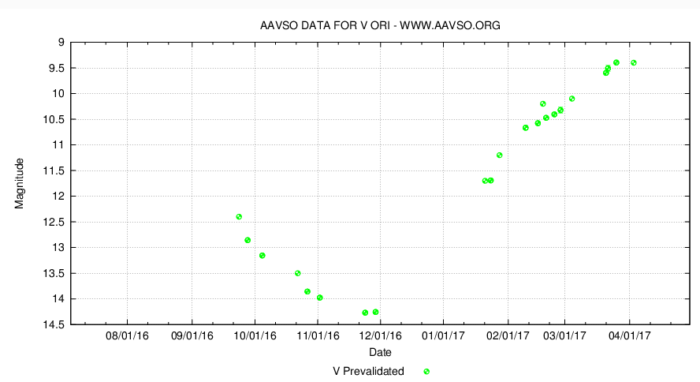
V Ori is a Mira type variable star that varies between 8.9 - 14.7 in V band over a period of approximately 267 days. Mira type variables are cool red giant stars that vary in brightness by over 2.5 magnitudes over periods that range from 80 to over 1000 days. The stars are in their late stage of life, fusing helium at the core and a swelling outer layer that is only weakly bound to the star. The star will eventually stop fusing, and transition to a white dwarf with a planetary nebula surrounding it. The pulsation is thought to be caused by shock waves originating from the star and traveling out through the extended shell.
Color image of V Ori taken on March 21, 2017, when it was around magnitude 9.6 in V visual band.
Light curve of V Ori, looking like it is near its peak on April 1st.
- Details
- Category: Stars
- Telescope: EDT 80mm Reftactor
- Camera: Atik 314l+