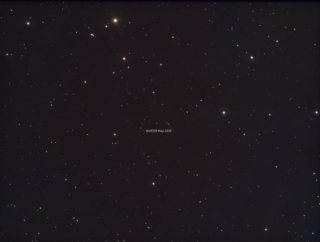
- Constellation: Leo
- Right Ascension: 10h 56m 28.99s
- Declination: +07° 00′ 52.0″
- Distance: 7.8 ly
Wolf359 is a red dwarf star at a distance of 7.8 light years away from Earth. Located in the constellation of Leo it is one of the nearest stars. It is also one of the faintest low mass stars known. So despite its closeness, it takes a telescope to see it as it shines at a dim magnitude 13.5. A relative young star at less than 1 billion years, as a red dwarf, it will survive for a trillions of years. It is also a flare star with a high rate of flares. It possibly has two planetary objects around it. The Wolf designation comes from Max Wolf who studied high proper motion stars and kept a catalog of them. It's motion can be seen over the years across the sky.
- Details
- Category: Stars
- Telescope: Explore Scientific 127 Refractor
- Camera: ZWO 1600 MM

- Constellation: Orion
- Right Ascension: 05h 55m 10.30s
- Declination: +07° 24′ 25.43"
- Distance: 700
Betelgeuse is a red giant star located in Orion. It is the largest star visible to the naked eye, if was located where our Sun is, it would extend out past the asteroid belt. It also a variable star with a magnitude range between 0 and 1.3. Attracting attention now as it is currently noticeably dimmer as one of the brightest stars in Orion. Because of its mass, it will have a short lifetime as stars go, and is expected to end as a supernova in less than a million years. At around 700 light years away it will be quite a show, with possibly brighter than a full moon at night and visible even during the day.
- Details
- Category: Stars
- Telescope: GSO RC10
- Camera: ZWO A071 Color
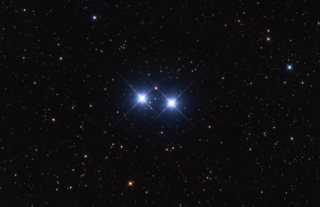
- Constellation: Lyra
- Right Ascension: 18h 44m 20.34589s
- Declination: +39° 40′ 12.4533″
- Distance: 162 ly
Epsilon Lyrae is a a true binary star system with an orbit that is measured in hundred of thousands of years to complete an orbit. In addition, each star is also a binary star that can only be split using higher powers. For this reason, it is often called the Double Double star. In addition an even closer in star has been detected around one of the stars.
- Details
- Category: Stars
- Telescope: GSO RC10
- Camera: ZWO A071 Color
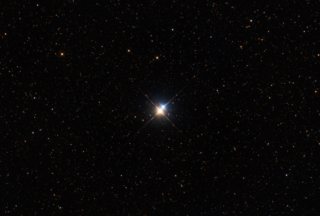
- Constellation: Cygnus
- Right Ascension: 19h 30m 43.286s
- Declination: +27° 57′ 34.84″
- Distance: 430
Albireo or Beta Cygni, is one of the finest double stars in the northern hemisphere. Located at the "beak" of Cygnus the Swan, the two stars show a vivid contrast in color. Although the two stars don't seem to be a true binary due to their distance between them and their motion across the sky. Just two stars passing in the night. However both stars do have companion stars that are too close in to be resolved by optical means.
- Details
- Category: Stars
- Telescope: GSO RC10
- Camera: ZWO A071 Color
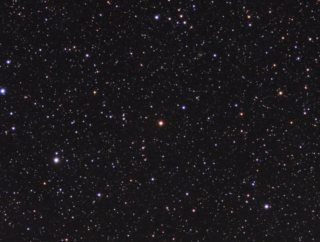
- Constellation: Ophiuchus
- Right Ascension: 17h 57m 48.49803s
- Declination: +04° 41′ 36.2072"
- Distance: 6 ly
Barnard's Star is a red dwarf star located 6 light years away in the constellation of Ophiuchus. Despite being relatively close, it is unable to be seen with out a telescope due to its dim nature. Being close by, and due to its motion, it displays the highest proper motion across the sky of any discovered star. That is, it appears to move across the sky faster than any other star.
I attempt to image it every year to show its motion across the sky.
- Details
- Category: Stars
Read more: Barnard's Star 2019
- Telescope: Explore Scientific 127 Refractor
- Camera: ZWO 1600 MM
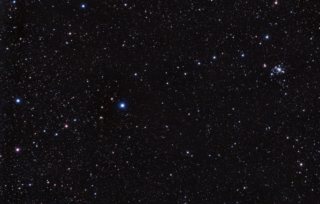
- Constellation: Camelopardalis
Kembles's Cascade is an asterism of unrelated stars that form some type of pattern. Kemble's cascade forms a line of brighter stars starting near the open cluster of NGC 1502 (upper right) that flows down towards the lower left of the image. It was named after a Franciscan friar named Father Lucian Kemble.
- Details
- Category: Stars
- Telescope: EDT 80mm Reftactor
- Camera: ZWO A071 Color