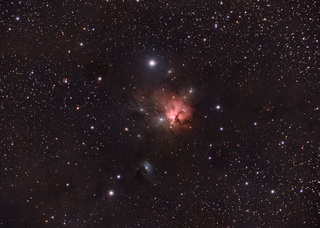
- Constellation: Perseus
- Right Ascension: 04h 30m 09.5s
- Declination: +35° 16′ 19″
- Distance: 2,100 ly
NGC 1579 is a nebula located in the constellation of Perseus. Often called the Northern Trifid because of its similarity to the Trifid nebula.
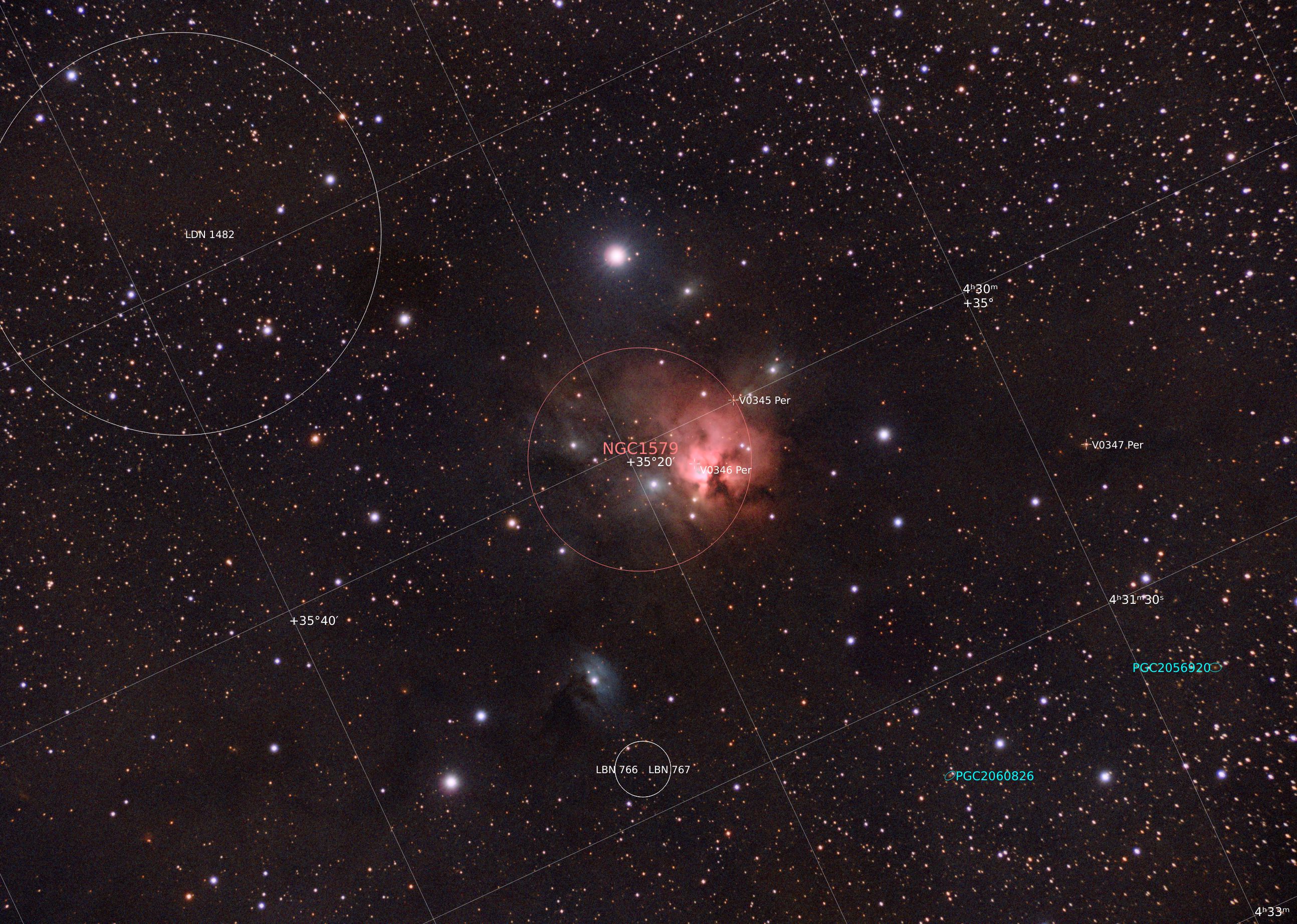
- Details
- Category: Nebulas
- Telescope: Explore Scientific 127 Refractor
- Camera: ZWO 2600 MM
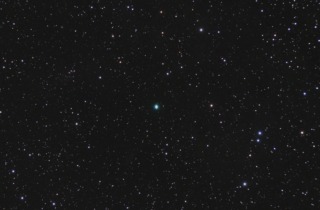
- Constellation: Aquarius
- Right Ascension: 21h 04m 10.877s
- Declination: −11° 21′ 48.25″
- Distance: 2,000 - 4,000 ly
NGC 7009 is a planetary nebula located in Aquarius. Of course the name comes from its resemblance to the planet Saturn. The way a planetary nebula forms of course is way different. A low mass star loses its outer layers during it's red giant phase before shrinking down in to a white dwarf. The nebula is glows from the ionization from the now white dwarf.
- Details
- Category: Nebulas
- Telescope: Explore Scientific 127 Refractor
- Camera: ZWO 2600 MM
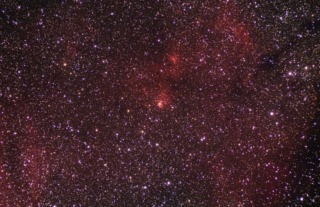
- Constellation: Cygnus
- Right Ascension: 20h 01m 48.1s
- Declination: +33° 31' 33"
- Distance: 28,000 ly
NGC 6857 was originally categorized as a planetary nebula, but its actually just a denser part of a larger HII region called Sharpless 2-100.
- Details
- Category: Nebulas
- Telescope: Explore Scientific 127 Refractor
- Camera: ZWO 2600 MM
- Constellation: Taurus
- Right Ascension: 04h 09m 16.98573s
- Declination: +30° 46′ 33.4699″
- Distance: 1520 ly
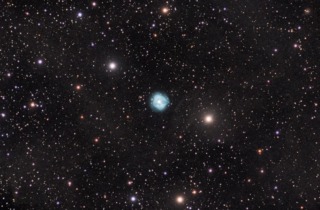
NGC 1514 aka Crystal Ball Nebula is a planetary nebula located in the constellation of Taurus. It was formed from a binary star system when one of the stars ejected gas and dust from its outer shell, in its late red giant phase.
- Details
- Category: Nebulas
- Telescope: Explore Scientific 127 Refractor
- Camera: ZWO 2600 MM
- Constellation: Sagittarius
- Right Ascension: 18h 03m 37s
- Declination: −24° 23′ 12″
- Distance: 4,100 ly
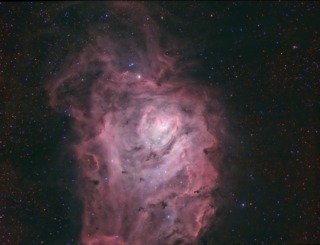
Messier 8 is a large emission nebula located in Sagittarius. Intense ultraviolet radiation emitted from hot young stars in the nebula cause the atomic hydrogen to glow a pinkish red. A star forming region, the nebula contains the open cluster NGC 6530 along with several Bok globules, which are dark collapsing areas of the nebula, along with 4 Herbig-Haro objects which are patches of nebulosity associated with newly born stars. The entire nebula spans a radius of 55 ly x 20 ly. It is one of only two nebula in the northern hemisphere barely visible as a patch of nebulosity. The other being the Orion Nebula.
- Details
- Category: Nebulas
Read more: Messier 8 - Lagoon Nebula (2022)
- Telescope: Explore Scientific 127 Refractor
- Camera: ZWO 2600 MM
- Constellation: Monoceros
- Right Ascension: 6h 39m 10s
- Declination: +8° 45′
- Distance: 2,500 ly
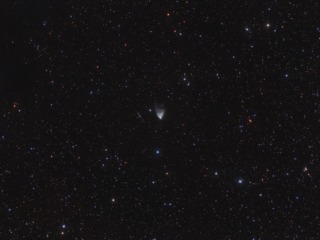
So named because of its changing light and dark patterns on the nebula is though to be caused by dust clouds near the illuminating source by the star R Monocerotis casting shadows on the nebula. The star itself a T Tauri variable, is encased dense clouds of dust.
The patterns are know to change over weeks and months. Discovered by William Herschel and studied by Edin Hubble.
- Details
- Category: Nebulas
- Telescope: Explore Scientific 127 Refractor
- Camera: ZWO 1600 MM