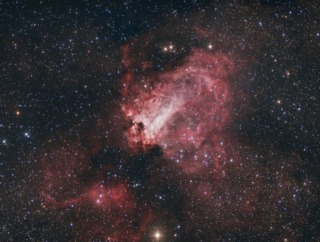
- Constellation: Sagittarius
- Right Ascension: 18h 20m 26s
- Declination: −16° 10′ 36″
- Distance: 5,000+ ly
Messier 17 is a H II region located in Sagittarius. Similar to the Orion Nebula, but more massive and viewed edge on. The main part of the nebula spans some 15 light years and is home to some current 800 stars with many more thousands being born in outer layers. At around 1 million years old, it is forming a young open cluster of stars.
- Details
- Category: Nebulas
- Telescope: Explore Scientific 127 Refractor
- Camera: ZWO 1600 MM
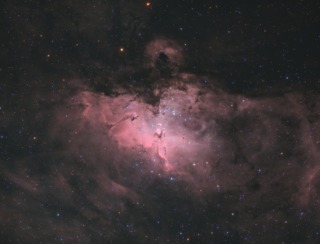
- Constellation: Serpens
- Right Ascension: 18h 18m 48s
- Declination: −13° 49′
- Distance: 7,000 ly
Messier 16 or as commonly call the Eagle Nebula, or Star Queen Nebula is an open cluster and nebula located in the constellation of Serpens. The central spires of dust and gas were made famous by the Hubble's "Pillars of Creation" image. The pillars and other regions of the nebula host new star formation. The central spire is some 9.5 light years in length. The age of the cluster is around 5 million years.
- Details
- Category: Nebulas
- Telescope: Explore Scientific 127 Refractor
- Camera: ZWO 1600 MM
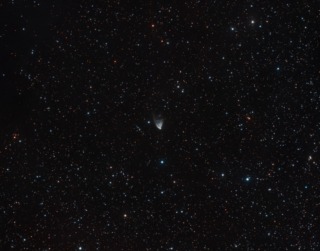
- Constellation: Monoceros
- Right Ascension: 6h 39m 10s
- Declination: +8° 45′
- Distance: 2,500 ly
The nebula patterns and brightness slowly changes over months and years from shadows of dust clouds illuminated by the star R Monocerotis, which in itself encased in a dust cloud. Discovered by William Herschel, and studied by Edwin Hubble who it is named after.
- Details
- Category: Nebulas
Read more: NGC 2261 (2020) Hubble's Variable Nebula
- Telescope: Explore Scientific 127 Refractor
- Camera: ZWO 1600 MM
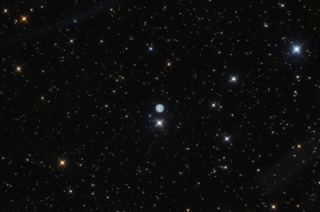
- Constellation: Gemini
- Right Ascension: 07h 29m 10.7669s
- Declination: +20° 54′ 42.488″
- Distance: 6,500 ly
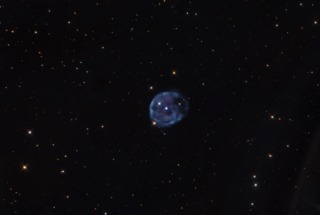
NGC 2392 is a planetary nebula located 6,500 light years away in Gemini. Sometimes called the Eskimo Nebula or Clown Face nebula as it resembles a head with a parka or other object around it.
- Details
- Category: Nebulas
- Telescope: GSO RC10
- Camera: ZWO A071 Color
- Constellation: Auriga
- Right Ascension: 5h 31m
- Declination: +34° 15′
- Distance: 7,000 ly
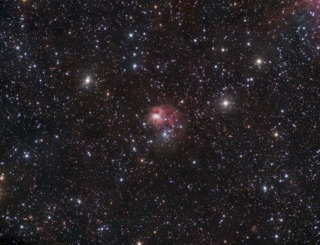
NGC 1931 an emission/reflection nebula located in Auriga. Sometimes referred to as a baby Orion nebula, and even has a Trapezium of four stars located in the nebula.
- Details
- Category: Nebulas
- Telescope: Explore Scientific 127 Refractor
- Camera: ZWO 1600 MM