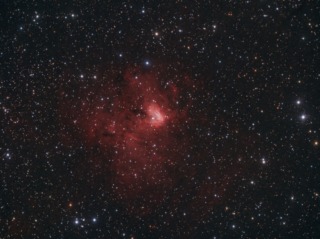
- Constellation: Perseus
- Right Ascension: 04h 03m 15.9s
- Declination: +51° 18′ 54″
- Distance: 11,700 ly
Emission nebula NGC 1491, sometimes called the Fossil Footprint Nebula located in Perseus. Located about 10,700 light years away. Illuminated by a 11.2 magnitude star actually blowing a bubble in the nebula from its intense stellar "wind".
- Details
- Category: Nebulas
- Telescope: Explore Scientific 127 Refractor
- Camera: ZWO 1600 MM
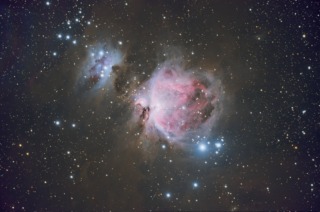
- Constellation: Orion
- Right Ascension: 05h 35m 17.3s
- Declination: −05° 23′ 28″
- Distance: 1,300 ly
Messier 42, The Orion Nebula is one of the most iconic deep sky objects and one of the brightest nebula, it can be seen as a fuzzy star in the sword of Orion figure. Illuminated by a central cluster of stars, the four primary ones are referred to as the Trapezium, for their shape of a trapezoid. As a stellar nursery it is in the process of forming new stars as pockets of the nebula collapse under gravity.
- Details
- Category: Nebulas
- Telescope: EDT 80mm Reftactor
- Camera: ZWO A071 Color
- Constellation: Lyra
- Right Ascension: 18h 53m 35.079s
- Declination: +33° 01′ 45.03″
- Distance: 2,567 ly
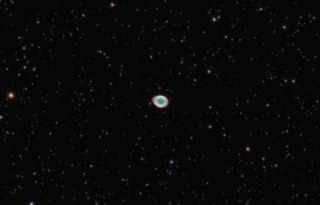
Messier 57 is a planetary nebula located in Lyra. A planetary nebula when a star nears the end of its life at the end of its red giant phase, the outer layers are blown off as the star shrinks down to be come a white dwarf. The exposed core of the star ionizes the surrounding gas causing it to glow. Planetary nebula typically only last a few ten thousands of years as the gas dissipates.
The blueish-green light comes from ionized oxygen, and the red outer layers come from ionized hydrogen. In deeper images it can be seen extending out much further. The central star shines at magnitude 14.8
- Details
- Category: Nebulas
- Telescope: Explore Scientific 127 Refractor
- Camera: ZWO 1600 MM
- Constellation: Taurus
- Right Ascension: 05h 34m 31.94s
- Declination: +22° 00′ 52.2″
- Distance: 6,500 ly
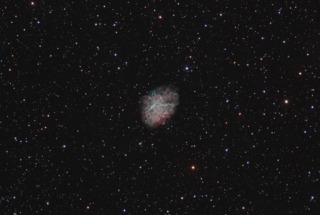
Messier 1 or the Crab Nebula, a supernova remnant from a star that went supernova in 1054 observed and recorded by Chinese astronomers. Being so bright, it was even visible in the day time. All that remains of the star is a neutron star that spins at 30 times a second that emits pulses of radiation. Such stars are called pulsars as the beam from their magnetic poles causes a pulse of radiation as they rotate. The expanding nebula is illuminated by the radiation outpouring from the pulsar and is expanding at the rate of 1,500 km/s.
- Details
- Category: Nebulas
- Telescope: Explore Scientific 127 Refractor
- Camera: ZWO 1600 MM
- Constellation: Cepheus
- Right Ascension: 00h 01m 08.58s
- Declination: +67° 25′ 17.0″
- Distance: 2,900 ly
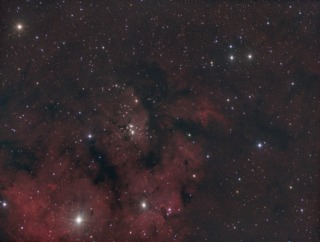
Image of part of an young emission nebula that spans 40 light years across located in Cepheus. The cluster is mostly illuminated by a star named BD+66, one of the hottest stars at 100,000 times more luminous than our sun. A young stellar nursery that is forming new stars from the clouds of dust and gas.
- Details
- Category: Nebulas
- Telescope: Explore Scientific 127 Refractor
- Camera: ZWO 1600 MM
- Constellation: Cygnus
- Right Ascension: 20h 59m 17.1s
- Declination: +44° 31′ 44″
- Distance: 2,590 ly
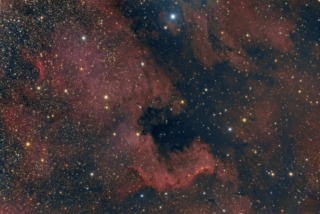
NGC 7000 North American Nebula a large emission nebula located in Cygnus. The nebula resembles a map of North America, with the dark lower center being the Gulf of Mexico, Mexico located in lower part of the image stretching around to Florida. The nebula and the joining Pelican Nebula in the top right are ionized by a hot O type star in the center.
- Details
- Category: Nebulas
- Telescope: EDT 80mm Reftactor
- Camera: ZWO A071 Color