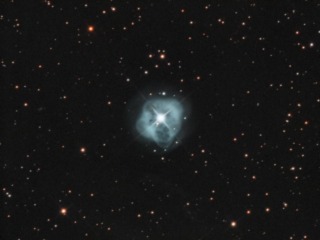
- Constellation: Taurus
- Right Ascension: 04h 09m 16.984s
- Declination: +30° 46′ 33.47″
- Distance: 2,200 ly
NGC 1514 is often called the Crystal Ball Nebula. It is a planetary nebula located in the constellation of Taurus. Discovered by William Herschel in 1790, it caused him to rethink the idea that nebulosity is just unresolved stars. The nebula is formed by a tightly bound pair of dying stars that are expelling their outer layers.
- Details
- Category: Nebulas
- Telescope: GSO RC10
- Camera: Atik 314l+
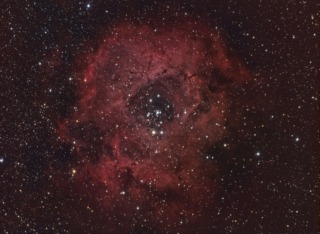
- Constellation: Monoceros
- Right Ascension: 06h 33m 45s
- Declination: +04° 59′ 54"
- Distance: 5,200 ly
The Rosetta Nebula, also known as Cadwell 49, and sometimes referred to as NGC 2244, although that actually refers to the open cluster in the nebula. The nebula is located in the constellation of Monoceros at a distance of 5,200 lightyears.
- Details
- Category: Nebulas
- Telescope: EDT 80mm Reftactor
- Camera: ZWO 1600 MM
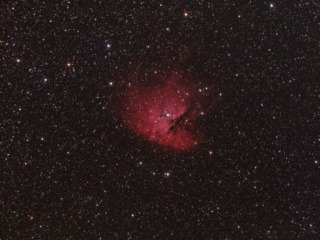
- Constellation: Cassiopeia
- Right Ascension: 00h 52m 59.3s
- Declination: +56° 37′ 19″
- Distance: 9500 ly
Also known as IC 11, or Sh2-184, and is occasionally referred to as the Pacman nebula due to its resemblance to the Pacman game's main character. The surrounding gas and dust is ionized by the open cluster IC 1590 which gives it a reddish glow. Several darker clumps can be seen which are called Bok globules. NGC 281 lies some 9500 light years away in the constellation of Cassiopeia. It was first noted by E. E. Barnard.
- Details
- Category: Nebulas
- Telescope: EDT 80mm Reftactor
- Camera: ZWO 1600 MM
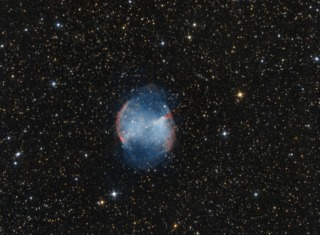
- Constellation: Vulpecula
- Right Ascension: 19h 59m 36.340s
- Declination: +22° 43′ 16.09″
- Distance: 415 ly
Messier 27 is often called the Dumbbell Nebula or Apple Core Nebula because of the brighter lobes on each side of it. It is located in the constellation of Vulpecula, at a distance of 1300 light years.
M27 is a planetary nebula which is a bit of a misnomer since it has nothing to do with planets. The first ones discovered looked a bit like planetary systems, but planetary nebula are created when a dieing star casts off its outer layers after a star's red giant phase. The nebula is made to glow from ionizing radiation from the remains of the star core which shrinks down to form a white dwarf.
Messier 27 was the first planetary nebula cataloged by Charles Messier.
- Details
- Category: Nebulas
- Telescope: GSO RC10
- Camera: ZWO 1600 MM
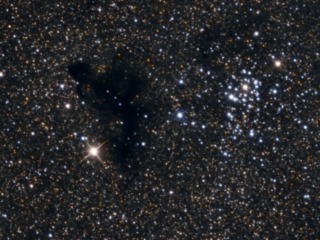
- Constellation: Sagittarius
- Right Ascension: 18h 3.5m
- Declination: -28 16m
- Distance: 5,100 ly
Barnard 86 is a dark nebula located in the constellation of Sagittarius. The nebula is dense enough to block the background stars in this densely populated area. Also visible is the open cluster NGC 6520, which may be associated with the nebula.
- Details
- Category: Nebulas
- Telescope: GSO RC10
- Camera: Atik 314l+
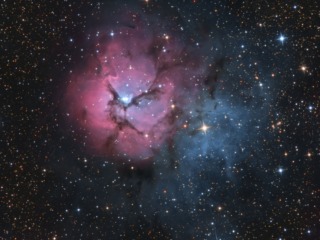
- Constellation: Sagittarius
- Right Ascension: 18h 02m 23s
- Declination: −23° 01′ 48″[
- Distance: 4,100 ly
Discovered by Charles Messier in 1764, the Trifid consists of several different components. First there is the open cluster of stars that formed from the nebula. The ionizing radiation from those stars causes the gas to glow with a reddish light. Reflecting star light of those stars off the surrounding dust gives us a blueish reflection nebula. Also visible are the thicker bands of dust and gas that give the nebula its name, roughly dividing it into three sections. The nebula lies approximately 5000 light years away in the constellation of Sagittarius.
- Details
- Category: Nebulas
- Telescope: GSO RC10
- Camera: ZWO 1600 MM