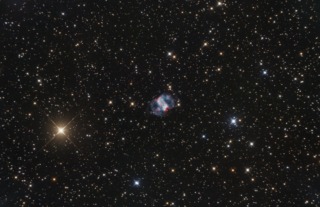
- Constellation: Perseus
- Right Ascension: 01h 42.4m
- Declination: +51° 34′ 31″
- Distance: 2,500 ly
Messier 76 is a planetary nebula located in Perseus. Sometimes referred to as the little Dumbbell Nebula or Barbell Nebula. Spanning around 1.2 light years across and located some 2,500 light years away makes it one of the more challenging Messier objects.
- Details
- Category: Nebulas
- Telescope: GSO RC10
- Camera: ZWO A071 Color

- Constellation: Andromeda
- Right Ascension: 23h 25m 54s
- Declination: +42° 32′ 6″
- Distance: 2,000 - 6,000 ly
One of these lights is not like the rest, tiny NGC 7662 aka The Blue Snowball. It is a planetary nebula located in the constellation of Andromeda. The bright star in the top left corner is 13 And.
Annotated image follows...
- Details
- Category: Nebulas
Read more: NGC 7662 The Blue Snowball Nebula
- Telescope: Explore Scientific 127 Refractor
- Camera: ZWO 1600 MM
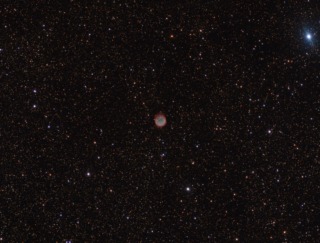
- Constellation: Aquila
- Right Ascension: 19h 18m 28s
- Declination: +6° 32′ 19.3″
NGC 6781 is a planetary nebula located in Aquila. It's outer shells blown off from the central star in its transition from red giant to white dwarf spans some two light years across.
- Details
- Category: Nebulas
- Telescope: Explore Scientific 127 Refractor
- Camera: ZWO 1600 MM
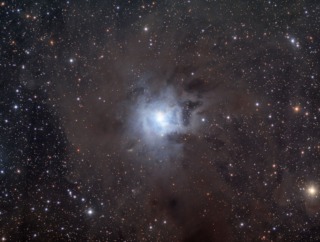
- Constellation: Cepheus
- Right Ascension: 21h 01m 35.60s
- Declination: +68° 10′ 10.0"
- Distance: 1,300 ly
NGC 7023 is a refection nebula, blue light from central hot young star SAO 19158 reflects off the dust grains illuminating the nebula. The nebula spans some 6 light years across. Spent some 33 hours imaging this object over August and September 2019.
- Details
- Category: Nebulas
- Telescope: Explore Scientific 127 Refractor
- Camera: ZWO 1600 MM
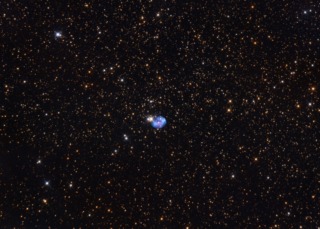
- Constellation: Cygnus
- Right Ascension: 21h 00m 32.503s
- Declination: +54° 32′ 36.18″
- Distance: 2,800 ly
NGC 7008 is a planetary nebula located in Cygnus. it is sometimes called the Fetus Nebula. The shell is unusual in that it appears to have two different shells. One possibility that it was a binary star system with two different shells formed from each of the stars as each star with through the same red giant phase.
- Details
- Category: Nebulas
- Telescope: GSO RC10
- Camera: ZWO A071 Color
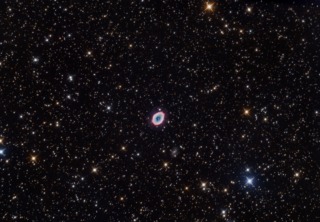
- Constellation: Lyra
- Right Ascension: 18h 53m 35.079s
- Declination: +33°01’45.03”
- Distance: 2,300 ly
M57 also called the Ring Nebula is a planetary nebula (planetary nebula have nothing to do with planets). They are formed when a star near the end of its evolutionary life expels its outer layers as it shrinks down to the white dwarf stage. The planetary nebula name comes from the early days when nebula such as this looked like planetary disks to the early observers.
- Details
- Category: Nebulas
- Telescope: GSO RC10
- Camera: ZWO A071 Color