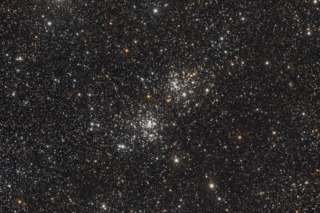
- Constellation: Perseus
- Right Ascension: 2h 20m
- Declination: 57° 08′
- Distance: 7,500 ly
The Double Cluster consists of two open clusters, NGC869 and NGC884 located in Perseus. Estimated age is 12.8 million years.
Although visible to the naked eye, they need optical aid to show the two individual clusters and to see them in all their glory.
- Details
- Category: Open Clusters
- Telescope: EDT 80mm Reftactor
- Camera: ZWO A071 Color
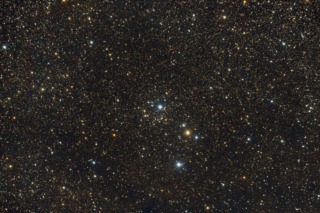
- Constellation: Vulpecula
- Right Ascension: 20h 11m 56s
- Declination: 26d 29m 20s
- Distance: 2,000
NGC6885 and NGC6882 are a pair of overlapping open clusters located in Vulpecula. NGC 6885 is the small group of brighter stars, and NGC 6882 is the set of fainter stars or possibly it is Collinder 416 as there is some confusion from William Herschel observations. Age is estimated at 1.4 billion years.
- Details
- Category: Open Clusters
- Telescope: EDT 80mm Reftactor
- Camera: ZWO A071 Color
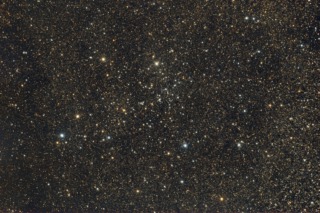
- Constellation: Serpens
- Right Ascension: 18h 38m 31.2s
- Declination: +05° 29′ 24″
- Distance: 1,300 ly
An open cluster located in Serpens located about 1,500 light years away. Somewhat difficult to pick out against the dense background stars of the Milky Way.
- Details
- Category: Open Clusters
- Telescope: EDT 80mm Reftactor
- Camera: ZWO A071 Color
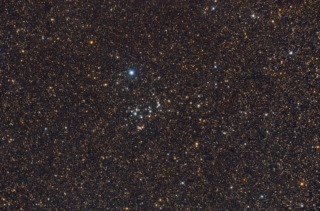
- Constellation: Ophiuchus
- Right Ascension: 18h 27.7m
- Declination: 6° 34′
- Distance: 1,000 ly
NGC 6633 Open cluster located in the rich star fields of Ophiuchus. It contains around 30 stars and is about 1,000 light years away with an estimated age of 600 million years.
- Details
- Category: Open Clusters
- Telescope: EDT 80mm Reftactor
- Camera: ZWO A071 Color
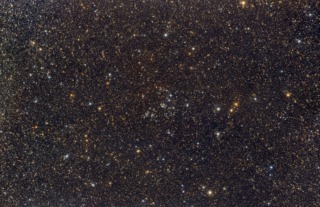
- Constellation: Lacerta
- Right Ascension: 22h 15m 08.6s
- Declination: +49° 53′ 51″
- Distance: 2800 ly
NGC 7243 is an 6th magnitude open cluster located in Lacerta. The cluster contains around 40 members in a large and sparse cluster. It's estimated age is around 100 million years.
- Details
- Category: Open Clusters
- Telescope: EDT 80mm Reftactor
- Camera: ZWO A071 Color
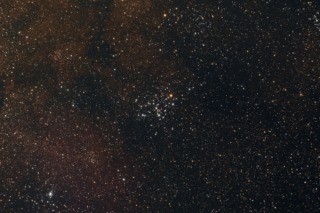
- Constellation: Scorpius
- Right Ascension: 17h 40.1m
- Declination: −32° 13′
- Distance: 1,600 ly
An open cluster located Scorpius. The name derives from Robert Burnham's description that it resembles an outline of a butterfly with open wings. The cluster is estimated to contain up to 300 members, and its age is 50 to 100 million years old. Like most open clusters, the stars will disperse over millions of years and become more background stars in Scorpius.
- Details
- Category: Open Clusters
- Telescope: EDT 80mm Reftactor
- Camera: ZWO A071 Color