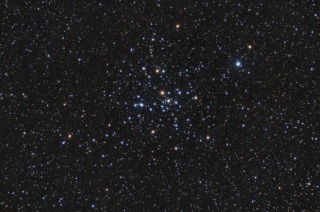
- Constellation: Canis Major
- Right Ascension: 06h 46.0m
- Declination: −20° 46′
- Distance: 2,300 ly
Messier 41 is an open cluster located in Canis Major near Sirius. The cluster contains some 100 members in a diameter of 25 light years. Estimated age of the cluster is around 200 million years. It is expected to remain as a cluster for 500 million years before dispersing. Brightest of the stars is an orange giant near the cent of the cluster. K3 type star, it has a magnitude of 6.3 and is 700 times more luminous than our Sun.
- Details
- Category: Open Clusters
- Telescope: Explore Scientific 127 Refractor
- Camera: ZWO 2600 MM
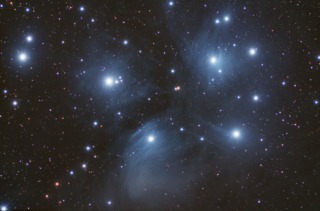
- Constellation: Taurus
- Right Ascension: 03h 47m 24s
- Declination: +24° 07′ 00″
- Distance: 444 ly
Messier 45, one of the more famous open clusters. Often called the Pleiades or the Seven Sisters, with the name Pleiades coming from Greek mythology. The cluster has been known since ancient times, and can be seen as a grouping of 6-7 stars, so it was interesting that Charles Messier included it in his catalog of objects that are not a comet, but could be mistaken for one.
The cluster is surrounded by a reflection nebula that the group is currently passing through, and not related to its original birth in a compact nebula. The cluster consist of at least 1,000 stars located in a radius of 8 light years. The cluster is dominated by hot blue luminous stars, but also contains many brown dwarfs that are not massive enough to initiate nuclear fusion. The estimated age of the cluster is around 100 million years, and its expected to take 250 million years to disperse due to gravitational interactions.
- Details
- Category: Open Clusters
- Telescope: Explore Scientific 127 Refractor
- Camera: ZWO 2600 MM
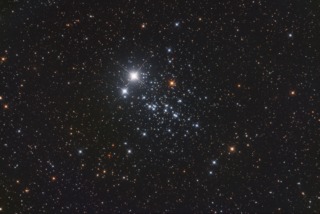
- Constellation: Cassiopeia
- Right Ascension: 01h 19m 32.6s
- Declination: +58° 17′ 27″
- Distance: 7,900
NGC 457 is an open cluster located in Cassiopeia, often called the Owl cluster, or a more recently the E.T. cluster with the two brightest stars forming eyes. I tend to see it more as an Owl. The cluster contains some 150 members and has an estimated age of around 21 million years. Less than idea weather for imaging, with a thin cirrus clouds, but a good bright target for commissioning the RC 10 scope and the ZWO 2600 mono camera.
- Details
- Category: Open Clusters
- Telescope: GSO RC10
- Camera: ZWO 2600 MM
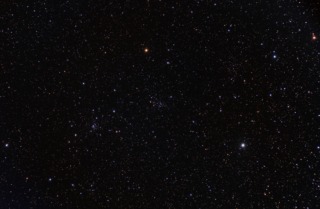
- Constellation: Cassiopeia
- Right Ascension: 23h 58m 24.2s
- Declination: +61° 12′ 30″
- Distance: 10,800 ly
NGC 7790, center of image is a young open cluster located in Cassiopeia with an estimated age of 60 to 80 million years. Open cluster NGC 7788 lies to the lower left of NGC 7790
- Details
- Category: Open Clusters
- Telescope: Explore Scientific 127 Refractor
- Camera: ZWO 2600 MM
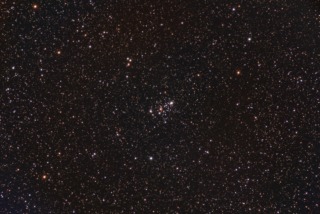
- Constellation: Cassiopeia
- Right Ascension: 01h 33.2m
- Declination: +60°42′
- Distance: 10,000 ly
Messier 103 is an ope star cluster located in Cassiopeia. Contains at least 107 members, its one of the smallest and at 10,000 light years one of the more remote clusters.
- Details
- Category: Open Clusters
- Telescope: Explore Scientific 127 Refractor
- Camera: ZWO 2600 MM
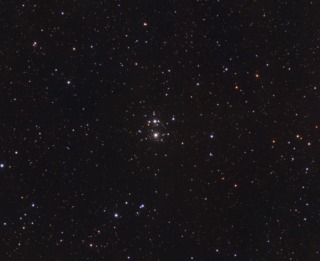
- Constellation: Gemini
- Right Ascension: 06h 01m 06.5s
- Declination: +23° 10′ 20″
- Distance: 7,200 ly
A small compact open cluster. Consisting of 37 likely members, within a radius of 4 light years. Estimated age is around 10 million years making it a young cluster.
- Details
- Category: Open Clusters
- Telescope: Explore Scientific 127 Refractor
- Camera: ZWO 1600 MM