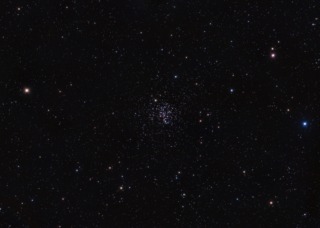
- Constellation: Cancer
- Right Ascension: 08h 51.3m
- Declination: +11° 49′
- Distance: 2,600+ ly
Messier 67 is an open cluster located in the constellation of Cancer. It is one of the older closest open clusters at an estimated age of 3.2 to 5 billion years. Most clusters tend to disperse after their formation, but M67 is expected to stay together for another 5 billion years. It contains at least 500 members and has undergone mass segregation where the more massive stars have migrated towards the center of the cluster.
- Details
- Category: Open Clusters
- Telescope: EDT 80mm Reftactor
- Camera: ZWO A071 Color
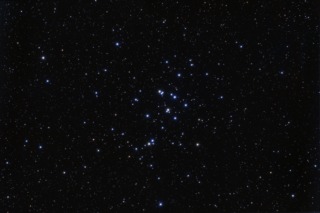
- Constellation: Cancer
- Right Ascension: 08h 40.4m
- Declination: 19° 59′
- Distance: 577 ly
Messier 44, or the Bee Hive Cluster, or originally Praesepe (the manger) is near by open cluster at a distance of 577 light years away. The cluster contains some 350 members. Visible to the naked eye, it has been known since ancient times as a "cloudy" star. Interesting its proper motion and age compares to the Hyades cluster suggesting a possible common origin millions of years ago.
- Details
- Category: Open Clusters
- Telescope: EDT 80mm Reftactor
- Camera: ZWO A071 Color
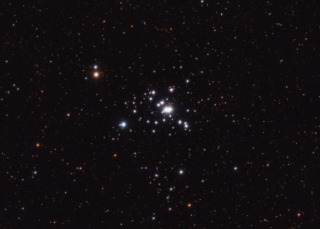
- Constellation: Camelopardalis
- Right Ascension: 04h 07.50m
- Declination: +62° 19.9
- Distance: 2,700 ly
NGC 1502 is an open cluster located in the constellation of Camelopardalis. It is near one end of a string of unrelated stars that seem to flow towards it that is called Kemble's Cascade. The cluster consists of around 45 stars and estimated distance of 2,700 light years away and is estimated to be a young cluster of around 11 million years old. The bright double star Struve 485 located near the center.
- Details
- Category: Open Clusters
- Telescope: Explore Scientific 127 Refractor
- Camera: Atik 314l+
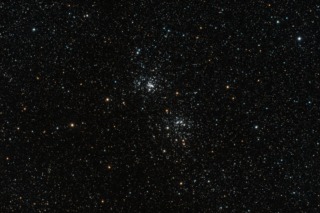
- Constellation: Perseus
- Right Ascension: 2h 20m
- Declination: 57° 08′
- Distance: 7,500
Located in the constellation of Perseus are the two open clusters of NGC 869 and NGC 884. Both are at a distance of around 7,500 light years away. Both are a relative young age of 13 million years. The clusters are separated by a few hundred light years. Each cluster consists 300 to 400 stars with NGC 869 being slightly brighter and more compact.
- Details
- Category: Open Clusters
- Telescope: EDT 80mm Reftactor
- Camera: ZWO A071 Color
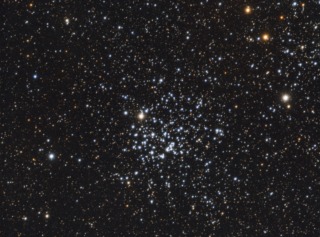
- Constellation: Cassiopeia
- Right Ascension: 23h 24.2m
- Declination: +61° 35′
- Distance: 3,000 - 7,000 light years
Messier 52 is an open cluster located in Cassiopeia. It contains around 193 members. Its estimated distance is between between 3,000 and 7,000 light years. The differences in distances are due to a large amount of interstellar dust in that direction that varies the brightness by an unknown amount.
- Details
- Category: Open Clusters
- Telescope: Explore Scientific 127 Refractor
- Camera: Atik 314l+
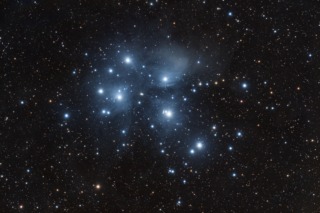
- Constellation: Taurus
- Right Ascension: 03h 47m 24s
- Declination: +24° 07′ 00″
- Distance: 444 ly
Messier 45 or as it is often called, The Pleiades. The name is possibly derived from ancient Greek word "plein" meaning to sail. It is often called the Seven Sisters as the brightest stars are named for the Greek mythological sisters of Atlas and Pleione, Alcyone, Electra, Maia, Merope, Taygeta, Celaeno, and Asterope or Sterope.
The reflection nebula around the cluster was originally thought to be left over dust from the clusters formation, but due to the age of the cluster, that nebulosity would have been dispersed. It seems it is just passing through an dusty region.
The cluster is an estimated 444 light years away, contains over 1,000 members and a large number of brown dwarf objects. Like most clusters, it will slowly disperse over millions of years. The cluster's age is estimated to be between 75 and 150 million years old.
- Details
- Category: Open Clusters
- Telescope: EDT 80mm Reftactor
- Camera: ZWO A071 Color