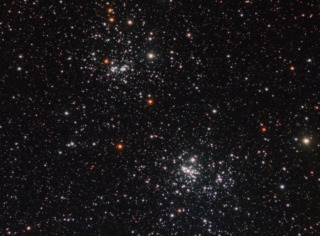
- Constellation: Perseus
- Right Ascension: 2h 20m
- Declination: 57° 08′
- Distance: 7,460 - 7,640 ly
NGC 869 and NGC 884 are commonly called the Double Cluster. Located in the constellation of Perseus, both are young clusters with an age of 12-13 million years old and are only separated by a few hundred light years. Estimated distance to the clusters is 7000 light years.
Oddly enough, Charles Messier didn't include them in his catalog, even though they were know from ancient times.
- Details
- Category: Open Clusters
- Telescope: EDT 80mm Reftactor
- Camera: Atik 314l+
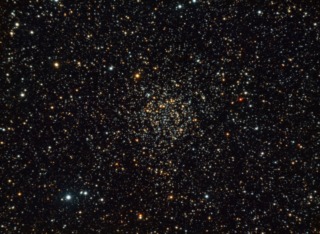
- Constellation: Cassiopeia
- Right Ascension: 23h 57m 24s
- Declination: +56° 42′ 30″
- Distance: 7,600 ly
NGC 7789 is an open cluster in Cassiopeia. Often called Caroline's Rose or The White Rose. It was discovered by Caroline Herschel in 1783. The cluster lies at a distance of 7600 light years away. I was curious about the particularly red bright star at the 2 o'clock position from the cluster. It is a red giant variable star of the Mira class, and its designation is WY Cas. In an approximately 476 day cycle, it varies from magnitude 16.9 up to a brightness of magnitude 10. It is near the peak in brightness in its cycle, but has no recent observations of its exact magnitude.
- Details
- Category: Open Clusters
- Telescope: EDT 80mm Reftactor
- Camera: Atik 314l+